A Rainy Afternoon at Home, Built Around One Table
A rainy afternoon at home can centre on one table activity, with an easy start, room for pauses and a natural stopping point before it drags.
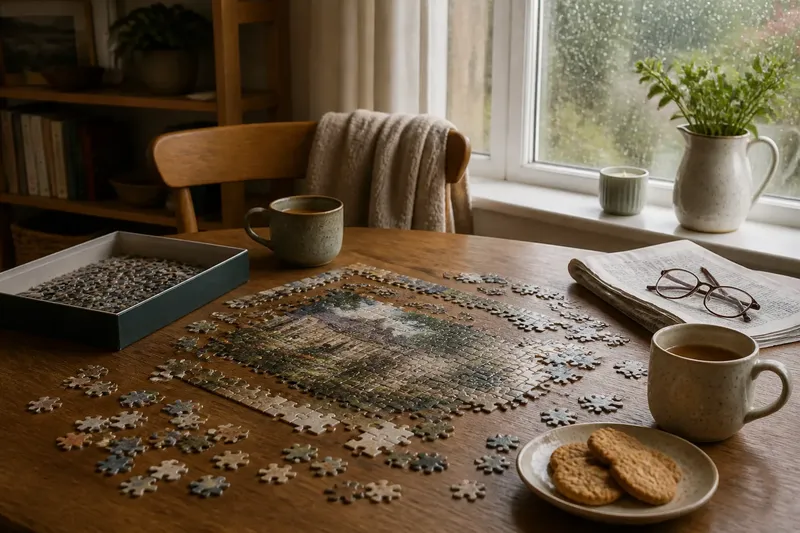
What can you do on a rainy afternoon at home without turning it into a project? Choose one table activity, set out only what it needs, and give it a natural stopping point. A jigsaw, a card game, a drawing session or a small repair can hold the afternoon without requiring it to become an occasion with a timetable.
The table is useful because it gives the activity a clear home. A cleared corner of the kitchen table is enough; there is no need to rearrange the room or produce a special atmosphere. Think of it as a tray: it keeps the activity together, while the rest of the day remains available for tea, reading or doing very little.
Choose a table activity
Start with the sort of attention the afternoon can bear. A jigsaw asks for steady looking and allows people to come and go. Cards offer a defined round and a quick reset. Drawing or collage leaves more room for improvisation, while mending a button or sorting photographs gives the hands a simple task and the mind somewhere to wander.
The best choice is not necessarily the most absorbing one. If the activity needs several people to remain attentive, or requires a long explanation before anyone can begin, it may feel less like a rainy-day pleasure and more like a meeting that has misplaced its agenda.
Consider who is likely to join and what they already know. A familiar card game works well when people drift in at different times. A jigsaw can accommodate a quiet guest who prefers to contribute without conversation. For children, choose materials that can be handled comfortably and an activity whose rules can be explained in a sentence or two.
Keep the decision modest. You are choosing what will occupy one stretch of an afternoon, not declaring a new household tradition. If the first choice feels wrong after a short while, putting it away is part of the plan, not evidence of failure.
Prepare a simple start
Clear enough space for the activity and for ordinary things that will appear beside it: mugs, a plate of biscuits, perhaps a folded newspaper. Put out the materials that are actually needed. For a collage, that might mean scrap paper, scissors, a glue stick and a sheet of backing paper. Extra supplies can stay in a drawer until someone asks for them.
Make the first action obvious. Shuffle the cards, turn the puzzle pieces face up, or place a few photographs in the middle of the table. A visible starting point helps people join without waiting for a formal invitation or a long explanation. If the activity has rules, leave them nearby rather than reciting them all at once.
Say, “I’m going to sort these pictures; join in if you like,” or ask a specific person whether they would like to play a round. A low-pressure invitation makes room for both company and refusal. On a wet afternoon, people may be content to listen from the sofa before deciding whether the table looks appealing.
Imagine you have gathered a handful of family photographs but do not want to organise the whole album. You place them on the table and sort them loosely into “keep nearby” and “put back”; someone else recognises a picture and joins the conversation. The activity has begun with no supplies beyond the photographs, and it can stop when the small pile is put away.
Keep the table usable
Leave a clear patch for drinks and hands. A coaster, a plate or a cloth can keep tea away from paper and cards without making the table feel precious. If the activity uses glue, paint or ink, protect the surface with scrap paper or a washable covering, and check the product label for any handling advice.
Keep personal belongings and unrelated chores off the active area where possible. A stack of post beside the puzzle can quietly turn into an invitation to deal with the post. Put it elsewhere before the activity begins; the table does not need to solve every domestic matter that wanders past.
For a shared activity, make room for different ways of taking part. One person may sort pieces, another may search for a particular colour, and someone else may mostly talk. The table need not enforce equal contribution. It is enough that people can reach the materials and understand what is happening.
At the same time, avoid spreading supplies across every available chair. A contained setup makes it easier to pause for lunch or let someone leave without dismantling the room. If the activity needs to stay laid out, clear a separate corner for cups and snacks rather than balancing them over the work.
Let the pace breathe
Once the activity is under way, resist the urge to keep it busy. A quiet stretch is not a problem to repair. People can work in silence, talk about something unrelated, or leave the table and return. The rain may be the main event for a while, particularly if it is making the windows sound unusually persuasive.
Offer small comforts without turning them into a second plan. Put the kettle on when it suits, open a window briefly if the room feels stuffy, or bring over fruit when someone asks. The activity should be able to survive these ordinary interruptions. If it cannot, it may be too elaborate for the kind of afternoon you wanted.
When energy dips, change the scale rather than adding a new activity. In a drawing session, switch from a detailed picture to quick sketches. With cards, play one shorter round. With a jigsaw, set aside a handful of pieces that are easy to recognise. A small adjustment can make continuing appealing without requiring a fresh decision about how to spend the day.
There is also no need to rescue a quiet group conversation by adding an activity. If people are talking more than they are drawing or sorting, let that happen. The table is a place to gather, not a supervisor monitoring productivity.
Find a natural ending
A good stopping point is part of the activity’s shape. It might be the end of a card round, the completion of one section of the puzzle, or the moment when the photographs have been sorted into a manageable pile. Choosing a finite unit at the outset makes it easier to finish without an abrupt announcement.
Notice the practical signs as well: people are repeating the same move, looking towards the clock, or starting to collect their things. These cues do not require a grand decision. You can ask whether anyone wants one more round, or say that you will pack up after the current hand.
Leave the table in a state that makes sense for the next part of the day. Return cards to their box, put tools away, and move unfinished work to a safe place if you intend to return to it. A puzzle can remain on a board or tray if that suits the household; loose pieces scattered beneath dinner plates are less charming.
If the activity has no neat endpoint, make one for the session. Settle on a small portion, such as sorting one envelope of photographs or drawing until the page is filled. This does not need a timer. The point is to stop while the activity still feels like something you chose, rather than a job waiting to be completed.
What fits a rainy afternoon?
What if people arrive at different times?
Choose an activity that can be entered without holding up the group, such as a jigsaw, collage or casual card game. Keep the materials visible and give newcomers a brief explanation of what is already happening.
How much space should the activity take?
Use one area large enough for the materials and a clear place for drinks. If the activity takes over the table, set aside a tray or board so it can be moved when the household needs the surface.
What if nobody feels like joining in?
Leave the activity ready for a little while, then put it away if it remains untouched. A rainy afternoon at home can include reading, resting or conversation; the table activity is an invitation, not an attendance requirement.
How do you avoid turning it into a project?
Choose one activity, limit the materials to what it needs and decide on a modest stopping point. Avoid adding a theme, a shopping trip or several related tasks unless those are what you genuinely want.
Keep it an afternoon
The pleasure of a rainy afternoon at home lies partly in its modest scale. One table, one activity and a clear way to begin are enough to give the hours a centre without filling every gap. When the activity reaches its ending, the rest of the day can remain unclaimed.
Before clearing everything away, ask whether there is anything you would like to leave ready for another day: a puzzle on its board, a sketchbook open to a clean page, or a deck of cards back in its box. Make only the small arrangement that will be useful. The rain may have stopped by then, but the table will still be there.